There was a time in my teaching when teaching in February felt overwhelming.
I remember getting up early every morning to exercise — not for fitness, but because it was the only way I could manage the feeling of carrying too much. Teaching felt like a constant mental and emotional load, and I needed that time just to steady myself before the day began.
This stage of the year can feel demanding for many teachers as resilience develops through everyday systems and routines.
It took time to move out of that place.
February didn’t always feel full and purposeful to me. That sense of capacity — of the classroom carrying more of the work — developed slowly, as resilience grows through ordinary relationships and predictable structures.
That’s why February now stands out to me — not as an easy month, but as a revealing one.
February Is a Full Month
February often comes layered with demands.
There are special days added to regular routines — Valentine’s Day, the 100th day of school. Professional development days may interrupt the week, sometimes more than once. Assessment is underway as report cards approach. And in many schools, there are large community events where classrooms are expected to showcase learning.
That is a lot.
By this point in the year, many teachers are making decisions continuously across long stretches of the day, which places increasing demands on executive function and self-regulation.
February isn’t light. But for many teachers, it’s also no longer fragile in the way the early fall can be. It’s a month where the classroom begins to show what it can do.
When the Classroom Starts Carrying the Work
One February, our entire school — Kindergarten through Grade 12 — held a large open house for the community. Families and visitors moved through the building, and students were expected to explain what they had been learning.
In my classroom, that responsibility didn’t sit with me. It sat with the students.
Students rotated through stations they had helped prepare, explaining what each one represented.
They spoke about projects they had worked on for weeks, and they answered questions, guided visitors, and took pride in their work.
This kind of responsibility supports engagement and growth when students are given meaningful opportunities to contribute to others.
This didn’t happen because February was easy.
Predictable classroom systems are known to reduce cognitive load and support independence over time.

What Becomes Possible by February
By this point in the year, many classrooms have more capacity than teachers realize.
Students often:
- move independently between tasks
- explain their thinking more clearly
- sustain focus for longer periods
- take ownership of shared projects
- manage materials and transitions with less support
These changes reflect the gradual development of executive skills such as planning, task initiation, and self-monitoring.
Teachers often:
- give fewer reminders
- make decisions more efficiently
- see patterns in assessment more clearly
- trust the classroom to hold complexity
February is busy — but it’s also a month where competence becomes visible.
Complex Work Doesn’t Have to Mean Chaos
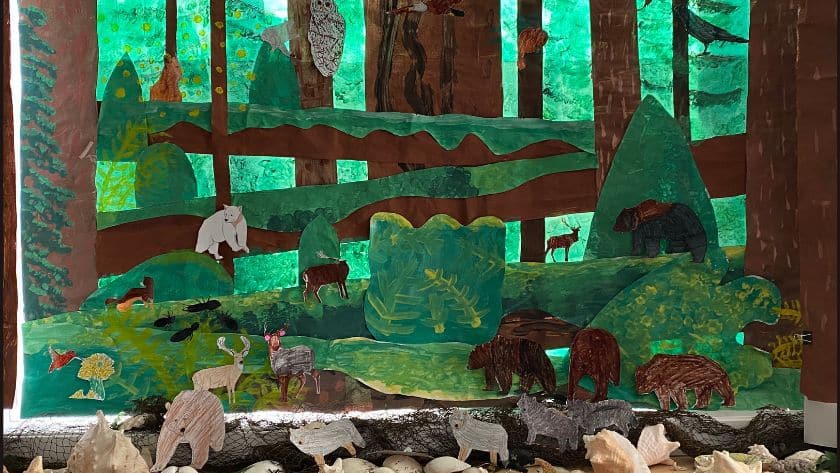
That same February, my students worked on a passion-based unit connected to environmental learning.
There were multiple strands running at once:
- a large forest mural
- a kelp forest and intertidal zone display
- a nonfiction book we wrote together
- interactive pathways through the room
- a “promise keeper” tree where visitors committed to one environmental change
The classroom could hold this complexity because predictable routines and relational safety support deep engagement.
There was movement. Noise. Preparation. Collaboration.
And there was also calm.
Not because the work was simple — but because the classroom could now handle complexity.

If This Doesn’t Feel Like Your February, Yet
For some teachers, February doesn’t look like this, yet.
And that doesn’t mean you’re doing anything wrong.
The kind of freedom and student ownership I’m describing doesn’t appear suddenly in February. It grows slowly, through routines and expectations that are taught, practiced, revisited, and protected earlier in the year.
This aligns with what we know about how self-regulation and resilience develop within supportive classroom environments.
Doubling down on routines isn’t about making the classroom more rigid. It’s about creating enough predictability that students can take on more responsibility — and teachers don’t have to carry everything themselves.
Over time, those routines stop feeling like effort and start feeling like support.
February as Evidence, Not a Test
February doesn’t need to be survived.
It can be observed.
It shows you:
- which routines are holding
- where students are ready for responsibility
- how much you no longer have to manage minute by minute
- what kind of work your class can sustain together
That doesn’t mean the month isn’t full.
It means the fullness has structure.
And that structure is something you built — or are still building.
Teaching in February
As you move through February, you don’t need to judge where your classroom is.
You might simply notice:
- one routine that’s holding more than it used to
- one moment where students take initiative without prompting
- one place where you can step back — even briefly
If your classroom is already carrying more than it once could, that’s worth acknowledging.
And if it isn’t there, yet, that doesn’t mean something has gone wrong.
It simply means the work is still unfolding.


