Why Do Classroom Expectations and Rules Sometimes Fail?
Many teachers begin the school year by writing a list of classroom expectations and rules on the board. Then you go through the same process.
- Students nod politely.
- Sometimes everyone agrees to sign the “contract”
- The list is posted on the wall.
Now, the real teaching can begin! And yet, within a few days, the teacher finds themselves repeating the same reminders again and again.
- Don’t interrupt.
- Don’t run
- Don’t shout.
And we start to feel like classroom expectations and rules are something we enforce rather than something students understand.
Over time, I noticed something important in my own classroom. When expectations were created with students instead of imposed on students, the entire tone of the classroom changed.
Students were far more willing to follow expectations that they had helped define.

What Will You Learn in This Article?
I spent nearly two decades working in classrooms and special education supporting students and teachers. Over time I noticed that many classroom rules failed not because teachers lacked authority, but because students did not fully understand the purpose behind them. The process I describe in this article grew out of those classroom experiences.
In this article I will walk through a simple classroom process that helps students understand and commit to classroom expectations.
- First, I will explain the difference between classroom rules and classroom expectations.
- Then I will show how I guide students in creating expectations together.
- Finally, I will explain why this process works so well and how you can apply it in your own classroom.
Clear expectations are one of the foundations of effective classroom management. This approach is one part of the Calm Classroom Framework, a system I developed to help teachers build calm, engaged, and predictable classrooms.
But before we begin . . .
What Is the Difference Between Classroom Rules and Classroom Expectations?
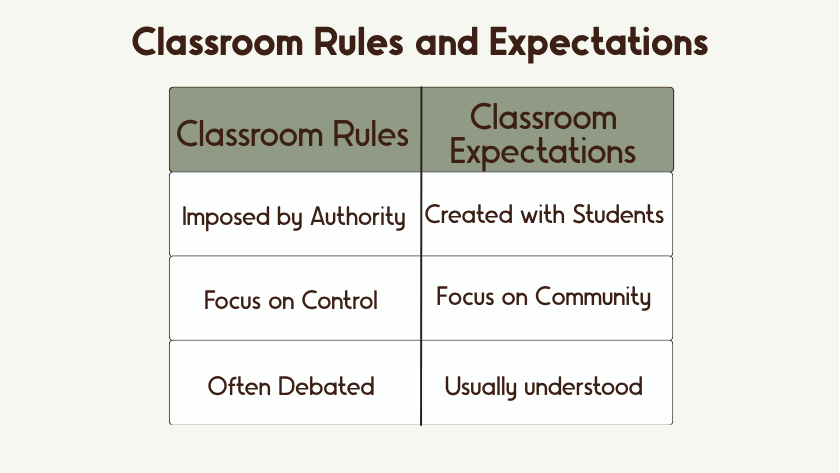
Classroom rules are typically imposed by the teacher to control behavior. Classroom expectations, on the other hand, are shared agreements created with students that describe how members of the classroom community treat one another so everyone can learn safely and respectfully.
Rules are what we tend to impose on students.
When rules are imposed, many students immediately begin testing them:
- Some children try to find loopholes.
- Others argue that they technically did not break the rule.
- Still others create ongoing disruptions, using the rules as an opportunity to model rebellion to their peers when the teacher is not looking.
And the moment a teacher finds themselves debating the wording of a rule, the student often feels they have won the contest.
Even if nothing serious has happened, the interaction becomes about authority rather than learning.
Why Classroom Expectations Work Differently
This is one reason I prefer to work with classroom expectations.
When expectations are created together, they are no longer something the teacher imposes. They become agreements that help everyone in the classroom feel safe and respected.
Within this process, the teacher becomes part of the community rather than the person standing outside it enforcing the rules. Because, and this is very important, the rules apply to the teacher too. So the teacher is protected, and also, the teacher is responsible for the rules.
For the sake of clarity in this article, I will occasionally refer to “classroom expectations and rules,” because teachers use both terms. But, as mentioned, the philosophy behind them is very different.
What Are Classroom Expectations?
Classroom expectations are shared agreements created with students that describe how members of the classroom community treat one another so everyone can learn safely and respectfully.
- How and when do we talk?
- What does respect look like?
- What can I expect when I am here?
I have watched this process unfold year after year in classrooms. When students understand why expectations exist and feel that they have a voice in creating them, their willingness to follow them increases dramatically. That is where the process begins.
What begins as a simple conversation about classroom behavior becomes an opportunity to build classroom community and social awareness.
Classroom expectations are shared agreements about how members of the classroom community treat one another so that everyone can feel safe, respected, and ready to learn.
Unlike rules imposed by authority, expectations are understood as mutual responsibilities that protect the learning environment for everyone.
Why Are Classroom Expectations Important?
Students want to feel safe, accepted, and respected in their classroom environment.
Even when they cannot articulate it clearly, most children recognize behaviors that disrupt that sense of safety.
When teachers invite students to reflect on what helps a classroom feel calm and respectful, students often identify the most important expectations themselves.
At the same time, many of the behaviors we are teaching—such as waiting to speak or controlling impulses—are connected to executive functioning skills that are still developing in childhood. Students need instruction, practice and guidance as they build these skills.
These behaviors are closely connected to developing executive functioning skills such as impulse control and self-regulation. This is one main reason conversations about expectations are so powerful.
Developing classroom expectations and rules gives students both instruction and understanding.
Where Do Classroom Expectations Come From?
Teachers often ask where classroom expectations should come from.
- Should you search online?
- Ask a colleague?
- Check with your principal?
Interestingly, my most reliable source for determining classroom expectations has always been my students.
Each year, when I ask students what behaviors help a classroom feel calm and safe, they consistently identify many of the same expectations.
When I ask students why expectations matter, they quickly provide examples.
Students often begin with statements such as:
- Don’t hit.
- Don’t shout.
- No running in the halls.
- Don’t interrupt.”
These responses appear almost every year.
The reason is simple. Students strongly dislike these behaviors when they happen to them.
At this stage of development, students may not yet recognize how their own actions affect others. Helping them make that connection becomes part of the teaching.
How Do You Turn Negative Rules Into Positive Classroom Expectations?
One of the first things I model during this discussion is the power of positive language.
When a student says “Don’t hit,” I might respond:
“I agree. I don’t want anyone to hit either. How do we stop other people from hitting us?”
Students might suggest things like:
- Use your words.
- Tell them to stop.
Then I guide the conversation a little further.
“Hmmm… how could we avoid getting hit in the first place?”
Eventually we arrive at a simple expectation.
We use our words and tell them, “Keep your hands to yourself.”
Students are usually very happy with this phrasing, and because they helped shape it, it feels like their idea.
Why Does Positive Language Work Better With Students?
There is a simple demonstration I like to share when explaining why I prefer positive language. I have used this with my students almost every year.
Try this yourself.
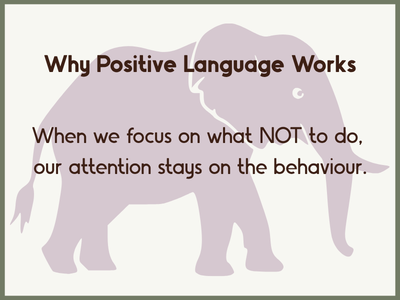
Set a timer for 30 seconds and try very hard not to think about a purple elephant.
So, what did you keep coming back to? For most people it was difficult to get that purple elephant out of their mind.
Most people quickly discover that the harder they try not to think about it, the more their mind keeps returning to it.
Negative language often works the same way. When we focus on what not to do, our attention remains fixed on that behavior.
Positive language helps shift attention toward the behavior we want students to practice.
In the classroom, this means teachers spend less time nagging about mistakes and more time reminding students what good choices look like.
Neuroscience research suggests that repeated practice is essential for building automatic habits. Students will need reminders about expectations either way. The difference lies in what those reminders emphasize.
How Do Classroom Expectations Help Students Develop Social Awareness?
Another powerful part of this process is helping students understand why expectations exist.
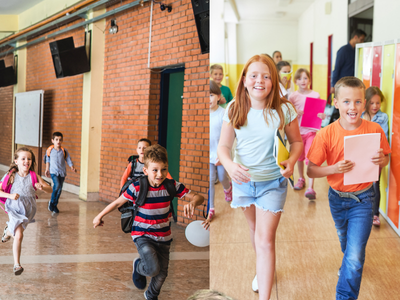
For example, students often mention running in the hallway.
When I ask why running in the hallway matters, students sometimes struggle to answer. After all, they may simply be trying to move quickly to where we have asked them to go. In their minds this might simply be making obedience fun.
This becomes a teachable moment.
I might ask:
“Have you ever been in a classroom where the teacher had to close the door because students in the hallway were making too much noise?”
Students usually nod.
“Was that distracting?”
Again, they agree.
“So when we run in the hallway and make noise, are we helping other classes learn?”
Students quickly recognize the connection.
From there, we can decide together that walking quietly in the school helps everyone.
Now the expectation has meaning.
What Classroom Expectations Should Every Classroom Include?
Although the exact wording may vary depending on the class, these expectations tend to appear in student language each year:
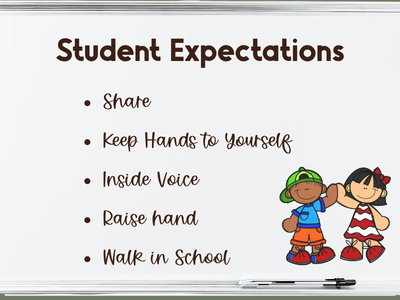
- Share
- Keep hands to yourself
- Be respectful to everyone
- Take turns
- Raise your hand to speak
- Listen to others
- Share your ideas
- Use an inside voice
- Walk in the school
- Do your job
The list does not need to be long. A short set of clear expectations is usually more effective than an extensive rule list.
How Do You Get Students to Agree With Classroom Expectations?
Once our list is complete, I ask an important question:
“Does anyone disagree with any of these expectations?”
This moment matters.
Sometimes a student raises a hand and challenges an expectation. Often they are simply being playful. Occasionally they are unsure whether they can succeed.
Either way, the discussion becomes an opportunity to model respect and patience.
If a student says they do not want to share, I might respond gently:
“That is okay. If something belongs to you, you can tell others not to touch it. But if we choose not to share classroom materials, that would mean we could not use any of the classroom materials either, because those belong to everyone.”
Usually students quickly recognize the logic.
The conversation reinforces that expectations protect the whole community.
What If a Student Says They Cannot Follow the Expectations?
Occasionally a student expresses concern about their ability to follow an expectation.
A child might say:
“I’m not sure I can remember to raise my hand.”
This is a wonderful opportunity to discuss effort and growth. And it is also a reality that we, as teachers, need to recognize.
Research on executive functioning shows that skills such as impulse control and turn-taking develop gradually throughout childhood. Students need instruction, modeling, and repeated practice as these skills develop.
Waiting to speak requires impulse control, which is an executive functioning skill that continues developing throughout childhood. Some students find this much harder than others.
When a student shares this concern, I respond with reassurance.
“I’m really glad you told me that. We can work on it together. I will give reminders, and as long as I can see you are doing your best, everything will be fine.”
This message helps students feel safe while still communicating that expectations matter.
Students also learn that doing their best is different from being perfect.
How Do You Enforce Classroom Expectations?
Once the discussion is finished, the process becomes very simple.
- Record the expectations clearly.
- Create a neat version for the classroom wall.
- Teach, practice, and reinforce the expectations
- Respectfully refer to the expectations throughout the year as necessary.
When a student struggles, enforcement becomes a conversation rather than a punishment.
I simply ask:
“Does that choice match the expectations we created together?”
Because the expectations belong to the class, the reminder feels collaborative rather than confrontational.

Or for teachers who want anchor charts in different areas of the room, I have created a collection for you. Follow this link to my store.
How to Create Classroom Expectations With Students
- Ask students what helps a classroom feel calm and respectful.
- Turn negative rules into positive expectations.
- Discuss why the expectations matter.
- Record the expectations clearly.
- Teach and practice the expectations throughout the year.
How Do Classroom Expectations Fit Into the Calm Classroom Framework?
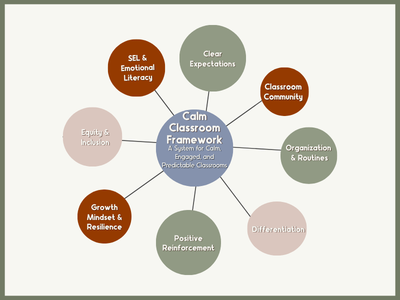
This idea is one part of the Calm Classroom Framework, a system that helps teachers build calmer, more predictable classrooms.
Clear expectations work best when they are connected with other classroom systems such as routines, positive reinforcement, and social-emotional learning.
Together these systems help students understand what to do, why it matters, and how their choices affect others.
Classroom expectations connect closely with several other pillars of the Calm Classroom Framework:
- Classroom Community — expectations protect relationships and belonging.
- Social-Emotional Learning — students develop awareness of how their behavior affects others.
- Organization and Routines — predictable structures reinforce expectations throughout the day.
When these elements work together, classrooms become calmer and more predictable.
A Simple Process for Creating Classroom Expectations
- Ask students what behaviors help a classroom feel safe.
- Turn negative rules into positive expectations.
- Discuss why expectations matter.
- Record the expectations clearly.
- Refer back to them throughout the year.
Classroom Expectations Examples
And, just as a reminder, there are a few essentials:
• Keep hands to yourself
• Raise your hand to speak
• Use an inside voice
• Walk in the school
• Share classroom materials
Final Thoughts on Creating Expectations With Students
Clear expectations do more than prevent misbehavior.
They help students understand how to participate in a community where everyone feels respected and ready to learn. Remember, their previous teacher likely had different expectations, so it is fair to make certain they understand the classroom expectations and rules of their new classroom.
When students help create those expectations, they are far more likely to take ownership of them.
And when that happens, classroom management becomes less about enforcement of classroom expectations, and more about shared responsibility.