
Differentiation in math instruction and play based learning go hand in hand.
Today I will
- What is differentiation in math instruction?
- The connection between differentiation in math and play based learning
- Small groups: Yes or No
- Simple ways to differentiate math
- Examples of activities for differentiation in math and play based learning
- Tools to support your students in the classroom
I am passionate about teaching math well because I failed grade 12 math. 😏
Twice. 🥴
As an avid reader I expected to be passionate about literacy, but, as it turns out, math is one of my personal favourite subjects to teach. This was entirely unexpected.
Math and Me
Growing up I was typically bored to tears in math class, and I just zoned out entirely during instruction. Eventually, of course, this caught up with me.
By the time I had reached high school I was way too far behind. I am a social creature. With group work, games, and more engaging activities I my focus could have improved. I love to learn by doing, and diverse instructional strategies would have undoubtedly engaged me more.
As mentioned earlier, I failed grade 12 math twice. So when I was hired as a math teacher I was terrified, but I had reviewed the material and realized I could teach it to myself.
I was surprised to discover my love of math when I was asked to teach grade 8 and 9 math. I was terrified, but I was put forward for the interview. Believe me when I say that I had to teach myself every single thing that I taught the students.
My ability to offer differentiation in math instruction was not a strength at that time. I was barely surviving, but I have learned along the way.
Getting Started Wtih Differentiation in Math
Other than my brief foray into middle school math, and periods of support in grades 3-6 classroom during my time in learning support, my classroom teaching focus was grades 1 and 2. Most years I taught combined grades. About half the time I taught the whole class, and the other half the time the students were always in their small group.
To be clear, there were still times when I was teaching whole group that we broke up into small groups. And there were definitely times during the small group instruction years that I taught the whole class.
However, essentially for whole group instruction I was planning one lesson, and for the small group years I was planning 3 group lessons.
What is Differentiation in Math?
According to Carol Tomlinson, a leader in differentiation in instruction, the strategies for differentiation fit under these 4 umbrellas:
Content – what the student is expected to learn and / or how the student will access to the information they need to learn it
Process – how the student interacts with or engages with the learning in order to learn
Product – how does the students demonstrate they understand the material
Learning environment – the way the classroom operates and feels to the students.
Many of the strategies do fit under more than one umbrella, which only makes life simpler!
For more on this find another blog post on differentiating math here.
Differentiation in Math Instruction and Play
To incorporate play into instruction and differentiation is to follow the principles of child development . Using play activities to differentiate learning optimizes aspects of development. Assessment has shown that differentiation through play develops multiple aspects of student development.
These play activities can be student led, but they are not necessarily. Assigning play based activities is successful as well.
There is also a spectrum as to what is defined as play based. In my classroom I included items that were clearly identifiable as games and other forms of play. However, I found the children were also highly engaged in play that allowed them to connect their learning with concrete objects like using counting collections.
To Group or Not to Group
In my experience the whole class instruction is fun and more dynamic. However, I do find that even with all of the ways I differentiated there was someone being pushed too hard, or being held back too long.
Small group instruction is better for teaching students more precisely at their level. However, even then there were still kiddos who were struggling to keep up. And it often times took me an hour to prep just that one subject.
However, then I learned something that helped a lot; differentiating numbers.
Differentiation of Numbers
This differentiation is super simple for tailoring instruction to students’ needs. If you change the size of the number, you are changing the challenge for the students.
As adults that add 2-digit numbers, we understand that adding 53 and 46 is not really that much more difficult than adding 23 and 16, but to timid students, the latter numbers are far less intimidating.
Additionally, for stronger students you may want to add numbers such as 44 and 37, and suddenly they are thrust into the world of independent problem solving as they figure out for themselves how to regroup. The next step is 55 and 48, and now they have crossed over into numbers bigger than one hundred. I would throw these regrouping equations in as a “Bonus Question” to let students know they were going above and beyond.
Great for early finishers.
Diffentiation in Math Using Dice
If you use dice, remember that 6-sided dice limit the difficulty far more than 10 or an 18-sided dice as the numbers go higher.
However, if you only have 6-sided dice, more advanced students can roll the 6-sided dice twice for each number in their equation? Once to determine the tens column, and then again to determine the ones column.
Examples of Differentiation in Math
As a former Learning Support teacher the first step I take to differentiate word problems in math is to make them accessible to everyone. What have I done to ensure the struggling reader who loves math is able to read the problem?
A. We want to keep engage students engaged, and not let them become disenchanted by a problem with reading.
- I read the problem aloud to the whole class. But this doesn’t really allow everyone to work at their own pace.
- Small group work so the reading is done by a peer.
- Partner work where students’ different strengths offer support to each other.
- My least favourite option because it can be cumbersome in the primary classroom is if you have a text-to-speech option.
B. Can you offer students choices as to ways to demonstrate their understanding?
- Maybe using an equation and showing their work.
- Could they create drawings that reflect the topic of the word problem (ie if the word problem is about baking cookies their drawings would be about cookies), and demonstrate their understanding of the math skill.
- What about building their answer with their favourite tool, and then providing a word or number sentence to connect what they have built with the problem?
- Personally I love John van deWalle’s big 5 assessment. It is very open-ended and provides choice for the students.
C. Write equations on the board or show pictures, and have students create word problems, verbal or written, for each other to solve. Have the students whose turn it is to solve the problem sit with their backs to the board, so they can’t see the clues.
Differentiation Math Questions
There are so very many ways that you can differentiate the same math equation. Posing the same question in different ways, and allowing the student to choose their question provides differentiation through choice and complexity.
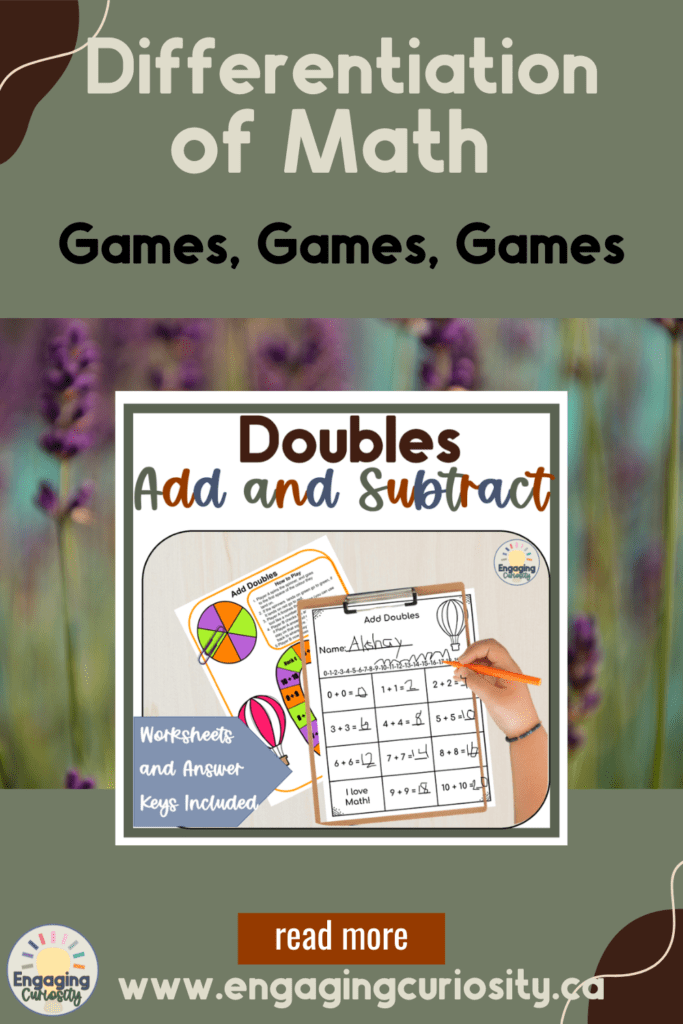
Let’s take a look at at a doubles equation: 4 + 4 = 8. Primary students are often quite confused with both equations and word problems if the unknown number is not in the sum or difference spot as in this video. Khan Academy also has an excellent video on the unknown number.
Move the Unknown Number to Different Spots to Change Complexity.
Check these differentiated math resources I created for Doubles Addition and Subtraction to support teachers with planning differentiation in math instruction.


Providing students with options for presenting their understanding is an effective part of differentiation in math instruction. Sometimes the option is using models or drawing pictures, and sometimes the option is by being up and moving around but still includes written work.
Using Student Recording Sheets to Differentiate
Student recording sheets can also be designed to support differentiation. A favourite math resource of mine, “Sums and Differences for grades 1 & 2” (this is NOT an affiliate link, but I loved it), by Carole Fullerton.
In a similar fashion, the Write the Room activities I shared with you above also come with differentiated worksheets.


All of these options come with or without a number line, and come with each resource for multiple ways of planning differentiation in math instruction, and multiple choices for each student.
Phew!! That is a lot of differentiated options.
An Opportunity to Easily Provide Work at a Student’s Individual Level
And that’s just for Doubles. 😉 By having similar task cards for other mental math strategies provides a multitude of options to suit any classroom need. 😅
Board games may offer a play based activity but with different output providing you with options for years.
Differentiation in Primary Mathematics Writing
Differentiated worksheets are just one way to provide your students with differentiated options for demonstrating their understanding through writing in math class. I loved having my students work in their journals.
You can:
- Differentiate the prompt complexity or challenge.
- Have a series of prompts available and during journal time students the next prompt in order. This differentiates by allowing everyone to work at their own pace.
- Offer a selection of ways to demonstrate understanding (ie: write an equation, write a word problem, draw a picture, explain their thinking, provide a fact family etc.), and have students choose 2-3 depending upon the skills you are working on at the time.
- Make journals one of the options on a choice board, so they can choose to write in their journal or do something else.
- Offer open-ended prompts for students and see how students demonstrate their understanding.
Differentiated Instruction in Math Using Different Tools
Note: The following links are not affiliate links. I provide them as a service to you.
Various tools for computation during differentiation in math instruction are helpful when planning your differentiation in math instruction, and these are what I consider the essentials. There are so many more.
Tools for Whole Class Use
There are some tools that are not only engaging, but they allow me to do some formative assessment on the spot. They are for the whole class.
Note: I am not earning commission from these links. They are solely here for your convenience and understanding.
- Plastic pockets for games, worksheets, and everything that you want to reuse.
- Whiteboard markers for using either on whiteboards or plastic sleeves
- Whiteboard erasers I have used these, but, truthfully, I just cut up washcloths for the students so that I could wash them. 🤢
- Handheld whiteboards these particular boards come with markers that aren’t great, but the boards are worth it!
- Magnetic 10 Frames are one of my favourite tools for using visuals to support student understanding of so many of the math concepts and strategies.
- Cuisenaire rods are a tool that are great for visual, kinesthetic and tactile learners as they can be used for multiple operations, fractions – if you are looking for resources with activities for how to use them please check out Carole Fullerton’s store. I taught the whole class using these, but at time when we weren’t using them the students could choose them.
- Versatiles students can practise and self-assess all the skills. These are also amazing at having students practice multi-step solutions and stretching short term memory. The down side is buying enough books for all of the skills for your students. These were always used for a center.
Tools That Students Had the Option to Use
- Make your own rekenreks or there are rekenreks you can purchase.
- Abacus although this is not the one I used. Different coloured beads for each group of 10, and strong wood construction are essential.
- 6 sided dice, 10 sided dice , 20 sided dice , the larger the number the tougher the equation. Students mostly had a choice, but occasionally their choice was encouraged.
- Dice inside dice are the same as using 2 six sided dice, but the kiddos loved them!
- Subitizing ten-sided dice are important for all students to use to practice subitizing., and they also add a little bit of extra challenge for students who need challenge but aren’t ready for 20 sided dice.
- Math links for counting, building, adding, subtracting, patterning etc.
- Magnatiles for making 2d to 3D shapes
- Tangrams great for spatial relations.
- Wooden Attribute blocks
- Number Line tape , but I did not tape this to the desks. I laminated each number line, punched a hole in one end, and hung them on the whiteboard with hooks.
These are all open ended tools; not flash cards or other prepackaged activities. Although some prepackaged activities existed in my classroom, they were few and far between.
Your budget is limited. Invest in tools wisely.
Get Started with Differentiation in Math Elementary Classrooms
There are many, many ways to provide differentiation in math classrooms, and we are all working with different curriculums. You may be tied heavily to a curriculum provided by a school or district, or you may wish you had more direction from your school or district.
What I have provided here is, obviously, not a curriculum, but hopefully there are ideas here that you can take one day and one step at a time. No two groups of children are going to be the same, so every time you explore a new thing, and take a new step of faith you are expanding your tool belt for the next group.
If you can’t afford the tools or resources I have linked to here, find something similar that will do the same thing. Or visit local garage sales, talk to friends and neighbours, and ask parents for donations.
Meanwhile, have fun in Math!!
If you do, I know they will. Engagement makes all other ways you provide differentiation in math that much better for students.
And remember, affirm yourself for the steps you are taking. Every step is a big deal.
Share one of your math tools for differentiation in math instruction in the comment below.
For more support in the classroom, check out my freebies down below.


